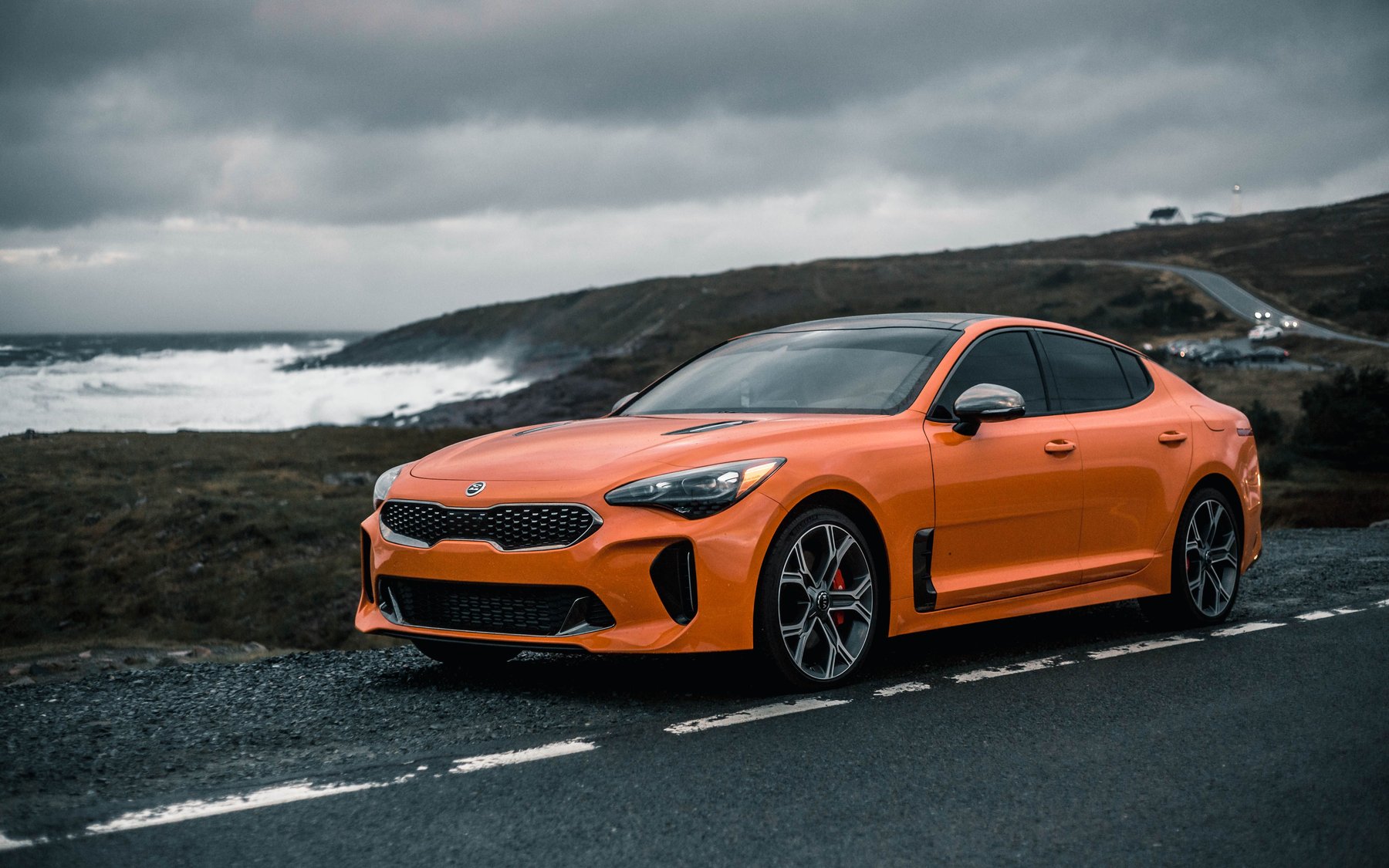
Power by stage
Stock is Kia's engine figure. Stage 1 to 4 are the tuners' own figures at the wheels (whp), mostly on US 91–93 octane, which is about 95–98 RON in Israel. The top of Stage 2 to 4 needs methanol injection or ethanol.
Names with an arrow go straight to that part's product page for this car.
Stage 1: Software, with new plugs
380–480 whpA flash tune takes the Stinger GT from about 310–330 whp to 380–480 whp, depending on fuel (LAP3's figures on a Dynojet). The JB4 piggyback is the most common alternative and needs no flash. European tuners quote engine figures: BR-Performance claims 400 hp and 610 Nm from the 366 PS car.
Typical cost: JB4 $799; flash tunes $499–$1,500 (Weistec, Tork, LAP3) or €780 (BR-Performance); plug-in modules €499–€899 (RaceChip, DTE); gearbox tune $150–$1,250 (Burger, Tork, LAP3).List prices, Sept 2026, before shipping, import tax and fitting.
Stage 1 tunes compared
| Tune | Fuel | Claimed power | Claimed torque | Notes |
|---|---|---|---|---|
| LAP3 Stage 1.0 / 1.5 | 91+ / 93+ US | 380–460 / 410–480 whp | — | HKS M45iL plugs required; 2018–24 cars |
| SleepyTuned custom tune | 91 / 93 US | about 420 / 440 whp | — | Its own estimates; flashed remotely |
| Burger JB4 | 91 US minimum; 91 / 93 / E85 maps | up to +100 whp | up to +100 wtq | Piggyback, 2018–23; 5-year warranty |
| Tork Stage 0 / Stage 1 | 91 / 93 US | up to +70 / +100 whp | up to +70 / +100 wtq | Engine computer sent in; Stage 1 needs intakes and HKS plugs |
| Weistec Lambda II tune | premium | 415 hp | 406 lb-ft | Engine estimate; Cypher tool, no unlock needed |
| BR-Performance Stage 1 | — | 400 hp | 610 Nm | European car; 2-year warranty |
| DTE PowerControl X | — | +62 hp | +147 Nm | Plug-in module for the European 366 PS car |
| RaceChip GTS 5 | — | +58 PS | +180 Nm | Plug-in module |
Recommended with Stage 1
- New or colder spark plugs required
Burger says spark blow-out is a known issue even at stock boost; LAP3 and Tork require HKS plugs.
- Gearbox (TCU) tune recommended
LAP3 TCU tuneTork 8-speed TCU tuneBurger TCU map
More line pressure and higher torque limits; SleepyTuned says the stock gearbox computer cuts torque on a tuned car.
- Gearbox oil cooler hot climates
BMS transmission coolerCSF Concept 3 cooler
Burger "strongly suggests" one for higher power or hot climates, which fits an Israeli summer.
Stage 2: Downpipes, intake and cooling
430–530 whpStage 2 adds downpipes, intakes and a bigger intercooler with a Stage 2 file. LAP3 claims 430–500 whp on 95+ octane, and 460–530 whp with methanol injection, which it requires for that file. Tork puts the stock fuel system's limit at about 470 whp without methanol.
Typical cost: downpipes $599.99–$695.75 (Circuit Werks, ARK); intake $379–$629.99 (BMS, aFe, K&N); intercooler $779 (BMS) or $1,499.95 (Mishimoto); Burger 450 whp package $1,299–$1,399.List prices, Sept 2026, before shipping, import tax and fitting.
Stage 2 packages compared
| Package | Fuel | Claimed power | Claimed torque | Required hardware |
|---|---|---|---|---|
| LAP3 Stage 2.0 / 2.5 | 95+ / 98+ or with meth | 430–500 / 460–530 whp | — | Bolt-ons; methanol injection required for 2.5 |
| Burger 450 whp package | — | over 450 hp | — | JB4PRO, intake, catch can and plugs |
| Tork Stage 1+ | with meth | +100 whp and more | +150 wtq and more | Full exhaust, intercooler and methanol |
Parts list
- Downpipes required
ARK Performance downpipesCircuit Werks downpipes
The V6 has primary and secondary downpipes; ARK's secondary pipes also fit the G70.
- Intake required
aFe Takeda intakeK&N Typhoon intakeBMS dual intake
aFe claims +22 hp; K&N measured +9 hp at the wheels.
- Intercooler recommended
Mishimoto intercooler kitBMS intercoolerWagner Competition intercooler kit
Mishimoto measured +8 whp on a stock tune and 6 whp more on Stage 1.
- Fuel for the top of Stage 2
BMS fuel pump upgradeBMS charge-pipe injectionBMS charge pipe
Burger calls the factory high-pressure pump the limit.
- Cat-back exhaust optional
MBRP cat-backMagnaFlow cat-back
Mostly sound; these are Stinger-specific and don't fit the G70.
Stage 3: Hybrid turbos and head studs
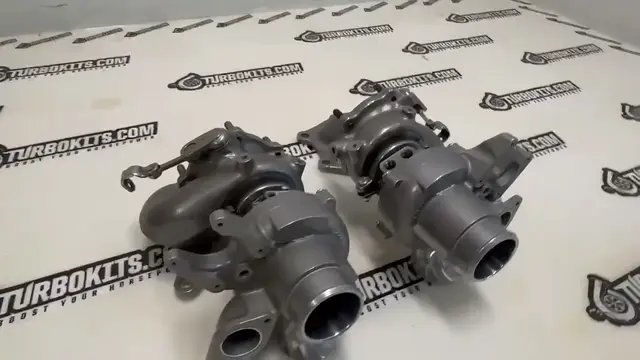
450–650 whpStage 3 upgrades both turbos. LAP3's hybrid files claim 450–550 whp on 93 octane and 500–650 whp with methanol, and TurboKits measured 615 whp on E30 and methanol with its TK700 turbos. From here the head needs studs: SleepyTuned says the stock torque-to-yield head bolts are shared with the non-turbo 3.3 and recommends studs above about 480 whp.
Typical cost: hybrid turbos $1,649.99 with core exchange (Pro Xe), $3,495 (TurboKits TK700) or €2,539.09–€3,108.20 (Muchboost); head studs $695.50 (Tork); port injection $1,999 (BMS).List prices, Sept 2026, before shipping, import tax and fitting.
Hybrid turbos compared
| Turbos | Fuel | Claimed power | Claimed torque | Notes |
|---|---|---|---|---|
| TurboKits TK700 | E30 + meth | 615 whp | 594 wtq | Head studs needed above 22 psi; fits the G70 |
| Muchboost 570 / 600 / 650 | — | about 570 / 600 / 650 hp | — | Engine figures; fits the G70 |
| Pro Xe LAMDA-680 | — | supports 680 bhp | — | A hardware rating; fits the G70 |
| LAP3 Stage 3.0 / 3.5 files | 93+ / with meth | 450–550 / 500–650 whp | — | For upgraded turbos |
Parts list
- Hybrid turbos required
TurboKits TK700Muchboost hybridsPro Xe LAMDA-680
Each needs a tune written for the new turbos.
- Head studs required
Tork head stud kit
LAP3 wants studs and block thread reinforcement from about 500 whp.
- Port injection for ethanol
BMS port injection kit
Six extra injectors and a pump; Burger claims up to 900 whp on E85.
- Gearbox upgrade recommended
Lambda Raceworks 8-speed build
A rebuilt automatic; no torque rating is published.
Stage 4: Big turbo kits and built engines
650–900+ whpStage 4 replaces the turbos and manifolds with a big-turbo kit, and at the top builds the engine. IMR claims more than 900 whp from its twin-turbo kit, and SleepyTuned says builds beyond 650 whp need forged internals and an upgraded drivetrain.
Parts list
- Big twin-turbo kit required
IMR twin-turbo kitLAP3 twin XT26 kit
Manifolds, turbos, wastegates and downpipes; both fit the G70 too.
- Built engine required
Lambda Raceworks "Bulletproof" 3.3Lambda Raceworks 4.1 race engine
Studs and block inserts, or a 4.1 with forged pistons and a 12-month warranty.
Quick answers
- How much horsepower does a stock Kia Stinger GT have?
- 365–370 hp from the factory, depending on the version.
- How much hp does a Stage 1 Kia Stinger GT make?
- Tuners claim 380–480 whp at Stage 1, up from 365–370 hp stock (Stage 1 options).
- How much hp does a Stage 2 Kia Stinger GT make?
- Tuners claim 430–530 whp with a Stage 2 file and the parts it needs (parts list).
- How much hp does a Stage 3 Kia Stinger GT make?
- Tuners claim 450–650 whp at Stage 3: hybrid turbos and head studs (Stage 3 parts).
- How much hp does a Stage 4 Kia Stinger GT make?
- Stage 4 is the top of the ladder for this car: big turbo kits and built engines. The biggest builds claim 650–900+ whp. Check which fuel each figure needs: Israel sells 95 and 98 octane only (Stage 4).
- How much does a Stage 1 Kia Stinger GT cost?
- List prices: JB4 $799; flash tunes $499–$1,500 (Weistec, Tork, LAP3) or €780 (BR-Performance); plug-in modules €499–€899 (RaceChip, DTE); gearbox tune $150–$1,250 (Burger, Tork, LAP3).
What we'd do
On the Stinger GT we would run Stage 1 with the gearbox side sorted, and stop there. LAP3's Stage 1.0 claims 380–460 whp on US 91, about our 95, and its Stage 1.5 410–480 whp on US 93, about our 98. Stock is 310–330 whp. That is a large gain from software and plugs alone, and none of it needs a part that requires approval.
Israeli cars came from Kia's importer, Talcar, so they are not US-market cars. LAP3 supports 2018–2024 cars but asks buyers outside the US and Canada to contact it first. Burger's JB4 ($799 for the V1) covers 2018–2023 cars, needs no flash and comes off again. BR-Performance (€780) writes files for the European 366 PS car. Ask any tuner to confirm your car's computer before you pay.
Buy in this order: plugs first (LAP3 asks for HKS M45iL gapped to 0.026–0.028 inch), then the tune, then a gearbox (TCU) tune and a transmission cooler. Burger “strongly suggests” the cooler for hot climates. Expect about $650–$2,750 for the tune and TCU file, plus plugs and the cooler, before shipping and tax. Add the BMS intercooler ($779) if you drive hard in summer.
What we would skip: Stage 2 on Israeli fuel. LAP3's Stage 2.0 needs US 95+ octane, which is race fuel by our scale, or methanol injection. Without one of them the downpipes and intake don't unlock a file you can run. Skip catless downpipes too, which won't pass the test. Above about 480–500 whp the head bolts become the weak point, so Stage 3 means head studs as well.
Tuning it in Israel
- New price in Israel
No longer sold new. Talcar launched the Stinger in 2018 with the 370 hp 3.3 Turbo GT from ₪379,900, rising to ₪389,900 on the 2020 price list (Cartube, 3 September 2018, with the 2020 update). A current car listing says the model is no longer sold new in Israel (cmotors, updated October 2026). We found no dated used-price source.
- Parts from abroad
At the Bank of Israel representative rate of 26 October 2026 ($1 = ₪3.078), with the Tax Authority's combined 40.66% for car parts and car electrical devices above $75 (see importing parts):
- Burger JB4 $799 × 3.078 = ₪2,459, plus 40.66% = about ₪3,459 (₪1,000 tax).
- BMS intercooler $779 × 3.078 = ₪2,398, plus 40.66% = about ₪3,373 (₪975 tax).
Add shipping before the 40.66%. A set of six plugs may stay under $75, which is tax-free if shipping is charged separately. A flash tune file has no import tax, but some tuners want the computer sent to them.
- Fuel
US 91 is about Israeli 95, and US 93 about 98. On 95, LAP3's Stage 1.0 is the file; on 98, its Stage 1.5. LAP3 says Stage 1.0 on 91 needs the stock primary downpipes. Its Stage 2.0 needs US 95+ and Stage 2.5 US 98+, both race fuel by our scale, unless you add methanol injection. The JB4 needs at least US 91. Methanol and E85 aren't sold at Israeli stations. See 95 vs 98.
- Regulation 380 and the test
Under Regulation 380 a special exhaust and accessories the maker didn't design are a change of structure. Downpipes, an intercooler or a cat-back need a certified part, a licensed installer and the change recorded in the licence. The 3.3 has primary and secondary downpipes, so check which catalysts a kit removes; catless pipes won't pass the annual test. Kia's warranty also excludes alteration and tampering.
- Where to get it done
Our list of Israeli dealers comes from the brands' own dealer pages. It has no entry for the tuners and parts makers in this guide (LAP3, Burger, SleepyTuned, Tork, BMS and others). Work with them remotely, or with a shop that knows the 3.3 V6. See tuning in Israel.
Prices and rules checked 2026-11-01.
Also useful: tuning shops in Israel, the import tax calculator and the annual test checklist.
What owners ask
- JB4 or a flash tune?
A new owner asked this on the Kia Stinger forum. A staff member who ran a JB4 for eight months, then switched to a flash tune, said he prefers the flash. He still called the JB4 plug-and-play and the easiest tune to remove. He added that the flash he used voids the warranty. Burger offers up to 100 whp and 100 lb-ft from the JB4 on a stock car, with a 5-year warranty on the unit. On a car you may want to return to stock, the JB4 is the simpler choice.
Sources: Kia Stinger forum: JB4 (July 2021), Burger Motorsports: Stinger 3.3 JB4
- Do I need new plugs, and what gap?
Yes. An early Stinger forum guide tells owners to check whether the tune needs colder plugs or a smaller gap. Its author closed his to 0.025 inch for a JB4. If the car misfires, take the tune off, inspect the plugs, then the coils. LAP3 asks for HKS M45iL plugs gapped to 0.026–0.028 inch. Burger says these engines are prone to spark blow-out even at stock boost, and suggests new plugs if yours have more than 25,000 miles.
Sources: Kia Stinger forum: helpful pointers for installing tunes (2018), LAP3: Stinger 3.3T ECU tune
- Should I fit a catch can?
Owners on the Kia Stinger forum disagree. Those in favour point out that the 3.3 is direct-injection, so fuel never washes the intake valves and oil vapour can build up on them. A former service manager argued against it, citing Kia's long powertrain warranty and its own fuel additive, and warned of warranty and emissions questions. Nobody measured anything. Burger's 450 whp package includes a catch can with the JB4, intake and plugs. We would treat it as maintenance, not power.
Sources: Kia Stinger forum: oil catch can or no? (2017–2018), Burger Motorsports: 450 whp package
- Can I run Stage 2 on pump fuel?
Not on Israeli pump fuel, going by LAP3's own table. Its Stage 2.0 claims 430–500 whp on US 95+ octane, and 460–530 whp with methanol injection. Stage 2.5 needs US 98+ or methanol, and LAP3 lists the exact nozzle and methanol mix. US 95 is well above Israeli 98. So the Stage 2 parts are only worth buying here if you are willing to run and refill a methanol kit.
Sources: LAP3: Stinger 3.3T ECU tune
Watch: real builds
From tuners', shops' and motoring journalists' own YouTube channels. Nothing loads from YouTube until you press play.
 1:04
 1:39
 25:37
New guides by email
One short email when a new car guide goes live. No spam, unsubscribe any time. We'll send a confirmation link first (by Brevo); see our privacy policy.
Questions to ask the shop
- Which flash tool and file do you use, and does my engine and gearbox computer's calibration support it?
- Is the file written for 95 or 98 RON without ethanol, and what boost does it run at peak and at 6,000 rpm?
- Which plugs do you require, and from what power do you insist on head studs?
- Will you tune the gearbox too, and do I need a transmission cooler for summer heat?
- Which downpipes keep their catalysts so the car passes the annual inspection, and can it go back to stock?
- Do you log and revise the file afterwards, and what happens to my warranty?
Same engine: 3.3 T-GDi: 1 more car with this engine
More Hyundai, Kia, Genesis guides: 7 cars
Which car should we cover next?
One new guide every week. Tap “Me too” on a car you want, or search for any car on our list. The most-requested cars get written first.