What hot air costs
When the air going into the engine gets hotter, the engine computer pulls ignition timing to protect the engine from knock, and power drops. The stock intercooler copes with one pull, but it warms up over several in a row, in traffic, or on a hot day. Makers call this heat soak, and their own dyno tests show what it costs:
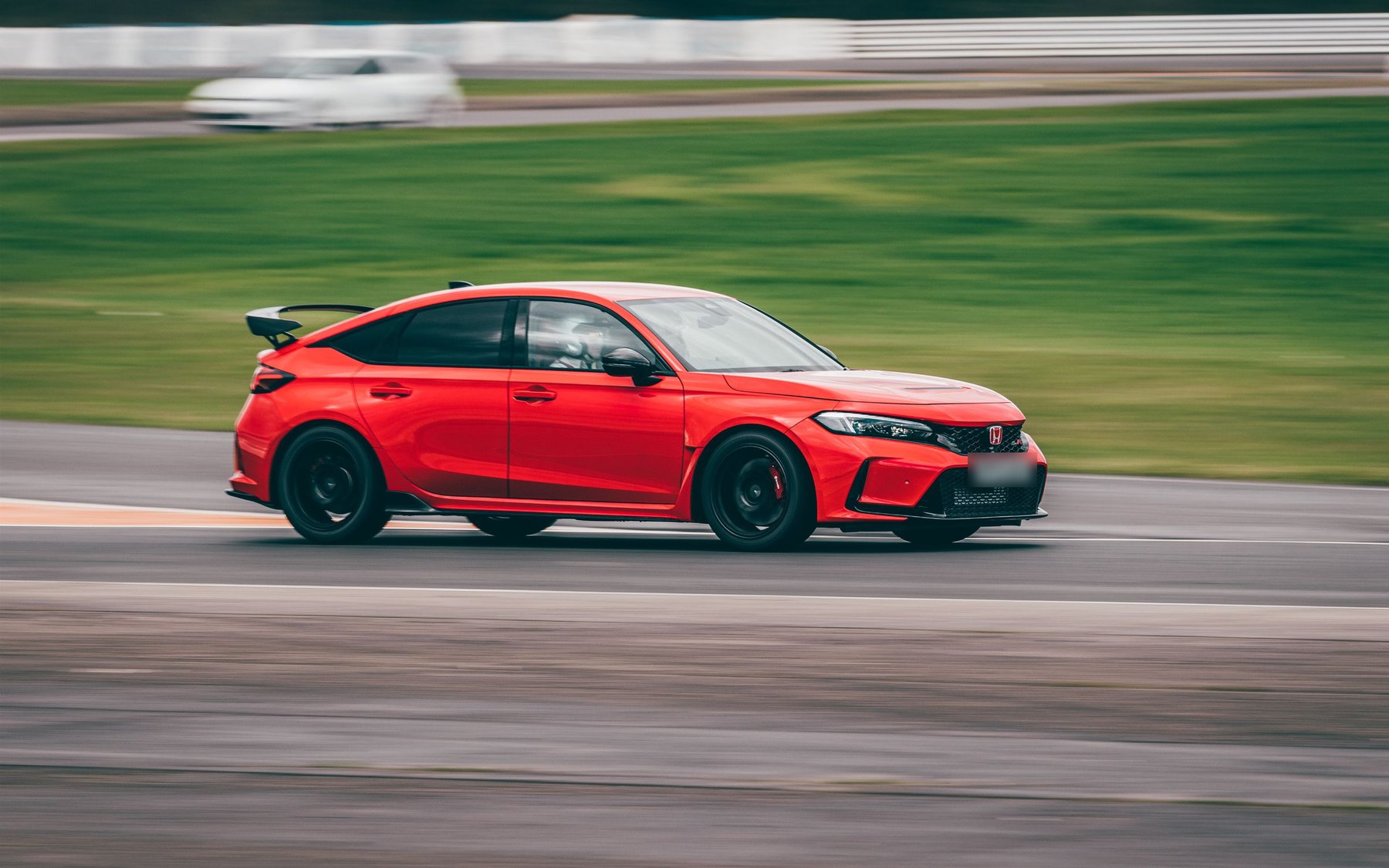
- Honda Civic Type R FL5, stock tune. Over six runs in a row the stock intercooler lost 21 hp; Mishimoto's larger one lost 10 hp (Mishimoto's test).
- Hyundai i30 N. After more than six pulls on a heat-soaked car, the air going into the engine was 48°C with the stock intercooler and 24°C with Forge's, in a 15°C test cell (Forge's test). Forge's explanation: in summer "the ECU then pulls out the timing to stop detonation".
- Civic FL5 again, back to back. PRL measured the stock intercooler already heat-soaked on the first pull at ≈58°C, climbing to ≈104°C (PRL's test).
Air-to-air or air-to-water
Most hatchbacks and the GT-R use an air-to-air intercooler: a radiator for the charge air behind the front bumper. It is simple and gives the lowest temperatures when the car is moving, but Mishimoto calls heat soak at idle and low speed its "most notable drawback". BMW's M cars and the Supra use air-to-water: the charge air is cooled by coolant, which a front heat exchanger then cools. Mishimoto says the circulating coolant "wards off heat soak, even at idle", but the system has more parts (Mishimoto's comparison). On an air-to-water car the whole loop matters, and CSF calls the front heat exchanger "the most cost effective way to bring down charge-air temps" on BMW's S58.
When do you need one?
- Stock or Stage 1, driven normally: usually not. Mishimoto says a factory intercooler is "often sufficient for casual driving".
- Stage 2 and up, track days or repeated hard pulls: this is where makers recommend it, and the tests above show why.
- A hot climate: do88 says that in hot weather "it doesn't take much of an effort from the engine to generate dangerously high inlet temperatures – even on a standard, non-tuned, car", and Forge calls its i30 N intercooler "essential" for a high-performance tune in a hot climate. That matters in an Israeli summer.
- The exception: Mishimoto calls the stock G80 M3 system "likely the best factory air-to-water system on any vehicle we have tested"; it held peak power within 1.5% over six runs (Mishimoto's G80 report). On a stock or lightly tuned S58, other parts come first.
Options and prices for ten cars
Two or three makers per car, with their own list prices and what their own pages measured or claim. The car name links to its full guide.
| Car | Factory type | Upgrade | Price as shown | What the maker measured or claims |
|---|---|---|---|---|
| VW Golf GTI / R Mk7, Audi S3 8V | Air-to-air, in front | Mishimoto intercooler | $849.95 | +14 whp on a Golf R Mk7.5, air out ≈13°C cooler |
| do88 MQB intercooler | USD 961.13 | 12°C cooler (24 against 36°C), core twice the size | ||
| VW Golf GTI / R Mk8 | Air-to-air, in front | do88 EA888 Gen4 intercooler | USD 1,177.98 | 12°C cooler and +12 hp on a stock GTI Clubsport 45 |
| Audi RS3 8V | Air-to-air, in front | Wagner EVO3 | $1,830–$2,130 excl. VAT | Standard up to 600 hp, X version above 600 hp |
| do88 RS3 intercooler (8V and 8Y) | USD 1,964.24 | Air in 23°C against 55°C stock | ||
| Audi RS3 8Y | Air-to-air, in front | Wagner EVO1 | $1,020 excl. VAT | 57% more volume than stock |
| Wagner EVOX | $2,130–$2,890 excl. VAT | 3.5 times the stock volume | ||
| BMW M3 / M4 F80 / F82 | Air-to-water: charge cooler on top, heat exchanger in front | Mishimoto heat exchanger | $698.95 | Coolant ≈6°C cooler |
| Mishimoto charge cooler | $1,595.95 | Air ≈7°C cooler with both parts, Stage 1 car | ||
| BMW M3 / M4 G80 / G82, M2 G87 | Air-to-water: cooler in the intake manifold, heat exchanger in front | Mishimoto heat exchanger | $649.95 | Bigger core; no temperature figure stated |
| CSF heat exchanger | $729.00 | Two rows against the stock single row | ||
| Toyota GR Supra A90 | Air-to-water: cooler in the intake manifold, heat exchanger in front | Mishimoto heat exchanger | $749.95 | Air ≈3–4°C cooler over six pulls |
| CSF heat exchanger | $699.00 | Air ≈6–8°C cooler on track | ||
| Honda Civic Type R FL5 | Air-to-air, in front | Mishimoto intercooler kit | $1,299.95 | Lost 10 hp over six runs, where stock lost 21 |
| PRL billet intercooler | $879.00–$949.00 | Bar-and-plate core: best for short bursts | ||
| Hyundai i30 N | Air-to-air, in front | Forge intercooler | £764.83–£775.52 inc. VAT | 24°C against 48°C stock after six hot pulls |
| Wagner Gen.2 (facelift) | $790 excl. VAT | Twice the stock volume | ||
| Nissan GT-R R35 | Air-to-air, in front (two cores) | AMS Alpha Street | $1,984.95 | For up to 1,000 hp |
| AMS Alpha Race | $3,599.95 | For 1,000–1,400 hp, or hot climates |
Prices as each maker's site showed them in September 2026, in its own currency, before shipping, import tax and fitting. Where a maker gave °F, the °C figure is converted (≈).
Before you buy
- Bigger is not free. A larger core can add turbo lag and block air to the radiator behind it, so look for a maker that publishes the pressure drop and a heat-soak test, not only the core size.
- Check the fit. do88 says its MQB intercooler needs the support frame trimmed on the S3 8V; Mishimoto says its Mk7 pipe kit's hot pipe may not fit the 7-speed DSG; AMS's biggest GT-R intercooler needs the factory crash beam cut.
- Crash structures and inspection. do88 says the crash bar that comes with its RS3 intercooler has not been crash-tested. Ask your shop whether a part that changes the bumper structure will pass the annual test and is fine with your insurer.